A Symbol Is Not a Secret Code
Learn how to interpret film symbols through context, recurrence, and visual choices, then compare readings against the scenes that support or challenge them.
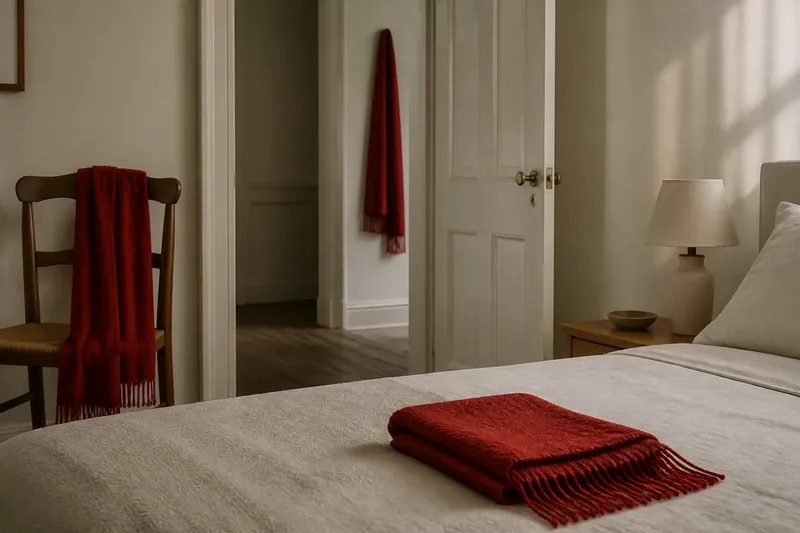
A red scarf appears on a chair, then in a doorway, then folded beside an empty bed. A viewer may wonder what the scarf symbolizes, as if the film has hidden a translation key in the frame. But a film symbol is not a secret code. Its meaning gathers through where it appears, what changes around it, and how the film teaches viewers to notice it.
That does not mean every interpretation is equally persuasive. A useful reading connects the image to details on screen. The scene, the image’s recurrence, and the film’s visual choices can each help explain what a symbol might mean.
Symbol and context
A symbol is an image, object, sound, or gesture that carries meaning beyond its immediate practical role. A key can open a door and also suggest access, permission, or control. Those associations are possibilities, not fixed definitions. The film’s scenes help narrow them.
Start with the object’s ordinary function. Notice who handles it, where it appears, and whether its use changes. A cup passed between two characters may matter because of the exchange, not because cups always symbolize intimacy. If the same cup sits untouched during a later meeting, the contrast may sharpen what the relationship has become.
Context includes more than plot. Framing, color, sound, timing, and performance can shape an image’s force. A flower shown in a bright close-up may feel different from the same flower glimpsed at the edge of a dark room. The object remains recognizable, but the film’s presentation changes its weight.
Keep the literal image in view. A reading becomes thin when it ignores what the object is doing in the scene. Ask first, “What happens here?” Then ask what else the image may be carrying.
Three ways to read
One approach treats a recurring image as a motif: a detail that gathers associations through repetition. This suits viewers who want to trace how an image develops without insisting on a single answer. A window might first frame a character’s curiosity, later become a barrier, and finally show an open view. The pattern matters more than a dictionary definition.
A second approach emphasizes the scene’s immediate context. Here, the image’s meaning depends on what characters are doing and feeling in that moment. This suits a close reading of a particular sequence, especially when the image appears only briefly. A closed umbrella during an argument may simply register the characters’ wet clothes and hurried arrival; its significance need not extend beyond the scene.
A third approach considers cultural associations. A mirror can evoke self-scrutiny, vanity, doubling, or the effort to recognize oneself. These shared visual conventions can prompt useful questions, but they are a starting point, not a verdict. The film may support one association, complicate it, or use the mirror for an ordinary practical purpose.
These approaches can work together. Begin with the scene, track repetition if it exists, and then consider broader associations. If an interpretation only works by skipping the image’s actual use, it needs a closer look.
Choosing a reading
Compare interpretations against the film rather than against how clever they sound. A strong reading accounts for relevant details: when the image appears, who encounters it, what the camera emphasizes, and whether its appearance changes alongside the story. It should also leave room for details that do not fit neatly.
Say you notice a recurring hallway light flickering whenever a character enters a house. Imagine an invented film in which the light also flickers while that character is absent and the family waits in silence. The idea that the light simply signals the character’s presence no longer accounts for every appearance. You might instead consider whether it marks uncertainty or tension in the household, then check whether the surrounding scenes support that reading.
This is not a hunt for proof that settles meaning once and for all. It is a way to make an interpretation answerable to what is on screen. Ask another viewer which details led them to a different reading, then return to those moments and compare what each interpretation explains.
- Track the appearances: Note where the image occurs and whether it is foregrounded or incidental. If it recurs in scenes with a shared concern, consider a motif reading; if it appears only once, focus on that scene instead.
- Identify its practical role: Ask what the object or image does in the scene. If its ordinary use affects the action, include that function in your reading; if it has no clear practical role, look at how the film presents it.
- Compare the surrounding action: Notice whether the characters’ choices or relationships shift. If a shift coincides with the image’s changing use, consider a connection; if not, avoid claiming the image marks that change.
- Notice form: Consider framing, color, sound, and duration. If one choice draws attention to the image, weigh it as part of the reading; if the image remains incidental, do not treat that feature as a universal signal.
- Test the reading: Look for an appearance that complicates your interpretation. If the reading accounts for it, keep it in consideration; if it does not, revise the claim or consider another interpretation.
- Separate association from evidence: List any cultural meanings that come to mind, then compare them with the scene. If the film supports one, use it cautiously; if the scene points elsewhere, let the film’s context take priority.
Choose the reading that explains the pattern with the fewest unsupported assumptions. If two readings remain plausible, the film may be sustaining both rather than asking you to select a winner.
Reading film symbols
Does a symbol need to repeat?
No. A single image can carry symbolic weight if the scene gives it unusual emphasis or connects it to a larger concern. Repetition makes a pattern easier to trace, but it is not a requirement.
Can an object mean several things?
Yes. A key might suggest access in one scene and responsibility in another, especially if its practical use changes. A strong reading explains those differences instead of forcing every appearance into one definition.
How can I tell if a reading is too vague?
Ask which specific scenes support it and what details would count against it. If the same interpretation could fit almost any object or film, it needs a closer link to this image’s actual appearances.
Should I look up a symbol’s meaning?
Outside associations can give you ideas, but they cannot replace the film’s own context. Treat them as questions to check against the scenes, not as a key that automatically unlocks the image.
Let uncertainty work
Some images remain unsettled because a film lets them carry competing feelings. A doorway may suggest escape to one character and exposure to another. A final shot may leave an object’s meaning open because the story has not resolved the conflict around it. That openness is different from a careless interpretation. The distinction is whether the reading stays connected to what the film shows.
When a film symbol seems to demand a translation, pause over the scene instead. Ask what the image does there, what its framing invites you to notice, and how its other appearances alter the answer. Context makes a reading clearer, but a film can still leave more than one thoughtful interpretation alive.