Why Some Films Begin at the End
Why some films begin at the end: see how a later opening reshapes suspense, memory, and the meaning of scenes as the story catches up.
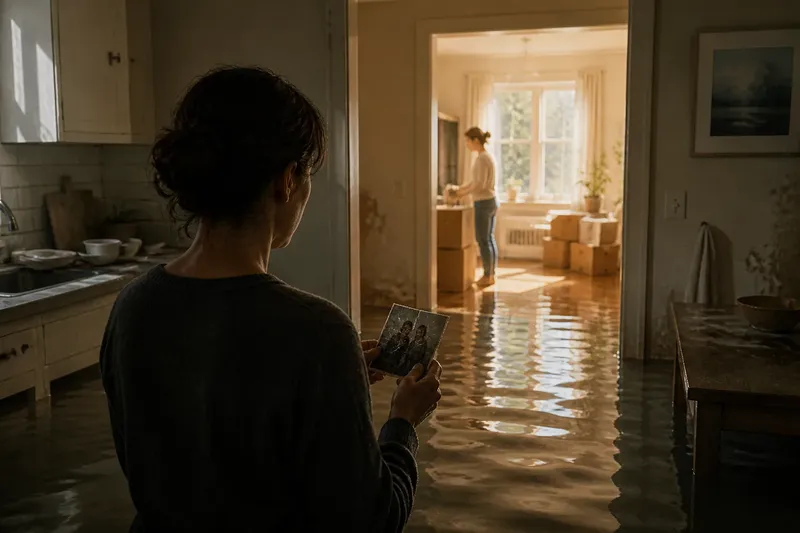
A film opens on a woman standing in a flooded kitchen, holding a cracked photograph. Then it cuts to a sunny afternoon, years earlier, when she first moved into the house. The opening has shown us a later event, but not how it happened. That gap changes what the earlier scenes ask us to notice. Why some films begin at the end becomes clearer when we follow the audience’s changing relationship to time: we watch the past while carrying an image of its possible future.
Chronology and presentation
A story has a chronology: the order in which its events happen within the fictional world. A film also has a presentation order: the sequence in which those events reach the viewer. In a straightforward chronological story, the two orders largely match. A film that begins near its ending separates them from the start.
The opening may show the final event, or merely a scene that occurs later than most of the film. These are not quite the same arrangement. If the first scene is truly the ending, the remaining story often explains how the characters arrived there. If it is a later moment but not the final one, viewers must also work out where that scene sits in the larger sequence.
This distinction matters because “starting at the end” does not necessarily mean giving away the ending. A frame can reveal a situation without explaining its causes, its emotional meaning, or what follows. A flooded room tells us something has gone wrong; it does not tell us who made a choice, what was lost, or whether the image belongs to a literal event at all.
Notice what the opening establishes and what it withholds. That boundary is where the film’s formal design begins to shape anticipation.
A future image as a question
A chronological opening often builds suspense by making the next event uncertain. A later opening can redirect that suspense. Instead of asking only, “What will happen?”, viewers may ask, “How did this happen?” or “What will this scene mean once I know more?” The basic source of tension shifts from an unknown future to an unexplained past.
That shift can make ordinary scenes feel charged. A character choosing a paint color, avoiding a phone call, or carefully folding a letter may seem to carry more weight because we have already seen a later crisis. The scene’s small actions acquire a shadow. Yet the opening image does not determine the interpretation. We may initially misread it, then revise our view when we learn who was present or what the characters knew.
Consider an invented film that opens with a man waiting alone at a train platform as a station worker closes the gates. The story then returns to a day when he and his sister planned a trip together. Viewers may wonder whether he missed her, abandoned the plan, or arrived after a different kind of loss. Each possibility encourages attention to their conversations, but none is established by the platform image alone.
The film can use that uncertainty without hiding every relevant fact. It can make the central question not simply whether the siblings reunite, but what their earlier promises meant to each of them.
Anticipation changes shape
Anticipation is not just guessing the plot. It is the mental activity of holding several possible outcomes open while watching. A later opening narrows some possibilities and enlarges others. If we have seen a character alive after an apparent disaster, we may stop wondering whether they survive and start wondering what survival costs them.
This changes how scenes are paced. A quiet conversation can become tense because the viewer is waiting for a detail that connects it to the opening. A sudden cut may delay that connection. A repeated line or location may invite comparison without explaining itself. The film is asking us to watch for relations between moments, not merely for the next incident.
There is a trade-off. Revealing a striking future image can reduce uncertainty about one outcome, but it can create curiosity about causes and consequences. If the image answers too much, later scenes may feel like a route to an already settled destination. If it answers too little, viewers may have no useful basis for connecting the timeline. The most effective balance depends on what kind of attention the film wants to sustain.
When watching, ask which question the opening has made more important. That question may change as new scenes arrive.
Memory on the second viewing
Reordered chronology makes viewers remember earlier scenes actively. After the film catches up with its opening, we can compare the image we first saw with the fuller context now available. Details that seemed incidental may become meaningful; details that appeared decisive may turn out to be misleading.
This is different from simply receiving a surprise. A surprise changes what we know at one moment. A retrospective reinterpretation changes how we understand material we have already watched. The film may show the same event twice, return to a location from another character’s perspective, or place a familiar image beside new information. Even without repeating footage, it can prompt us to replay the opening in memory.
That process can complicate sympathy. At first, a character in the later scene may appear cruel, frightened, or resigned. Later events can clarify the pressures behind the behavior without erasing its effects on others. The viewer’s first impression remains part of the experience, but it is no longer the only available reading.
On a second viewing, the opening may feel less like a riddle and more like an instruction about where to look. We may notice a pause, a direction of gaze, or a sound that had seemed decorative. The film has not changed, but our memory now supplies connections that were unavailable on the first pass.
Reading the time shifts
Films use several visual and sound cues to orient viewers, though no single cue has a fixed meaning. Changes in costume, lighting, weather, hair, or the condition of a room can signal a shift in time. A recurring object may link scenes across a gap. A voice-over can name a past event, while a cut between matching gestures may invite us to compare two periods.
Editing can also keep a shift deliberately uncertain. A scene may begin with the same framing as the opening, encouraging the viewer to assume a connection before a later detail corrects it. Sound can bridge separate moments, making a memory seem continuous with the present. These choices guide attention, but they do not always provide a complete timeline immediately.
- Notice changes in clothing, setting, and the state of familiar objects.
- Listen for repeated sounds or lines that connect scenes.
- Track what each character appears to know at different points.
- Ask whether a returning image confirms your first interpretation or revises it.
These observations are more useful than trying to construct a perfect timeline too early. A film may want viewers to feel uncertain about the order while remaining attentive to emotional or thematic links.
Questions about the structure?
Does a film that starts near the end spoil its ending?
It can reveal an outcome, but an outcome is not the same as an explanation. The film may shift attention toward the choices, losses, or relationships that give the visible event its meaning.
Why show a future scene before its causes?
The opening can establish a question that gives later scenes a second layer of attention. Viewers watch both what characters do now and how those actions might connect to the image already shown.
How can I tell when the story has caught up?
Look for a return to the opening’s location, action, or distinctive image, along with any change in context that clarifies the connection. Sometimes a film marks the meeting plainly; sometimes it lets the viewer recognize it through repeated details.
Can the opening still matter after its mystery is resolved?
Yes. Once the cause is known, the image can carry a different emotional weight, such as grief, relief, or regret. Its function may shift from prompting a prediction to helping viewers assess what the characters have become.
When the form carries feeling
Beginning near the end can make time feel less like a track moving forward and more like a set of memories that keep changing one another. A later image hangs over earlier choices, while those choices gradually alter the image’s meaning. The structure gives the viewer a task: hold the first impression, gather context, and decide what deserves revision.
That task can echo the experience of remembering. People often encounter a present detail that sends them back through an earlier event, not as a neutral record but as something newly understood. A film can create a similar movement without claiming that memory is perfectly reliable or that every past event has one hidden explanation.
When a story opens at a later moment, the question is not only where the scene belongs on a timeline. Ask what the film wants you to carry from it into the past, and what the past eventually asks you to carry back. That exchange is the distinctive force of why some films begin at the end: the opening is not simply a destination revealed early, but a memory the story keeps teaching us how to read.